Once I worked as an intern in the state capital. One of the representatives I worked for was this middle-aged guy. And he hated the tampon and napkin machines in the women’s bathrooms. Hated them. He insisted that they weren’t necessary.
I found out why after I’d been working there, oh, about a month. My period started suddenly, as it sometimes does, and I asked to excuse myself to go to the ladies’ room. He wanted to know why. I told him.
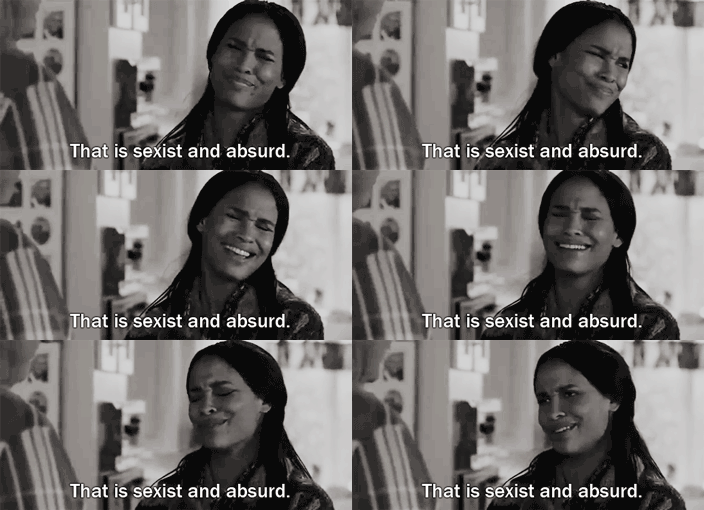
He started ranting about how lazy women were. How we wasted time. How we were so careless and unhygenic, and that there was no call for that. He finished by telling me that I certainly was NOT going to the ladies’ room and that I was just going to sit there and work. He finished this off with a decisive nod, as if I’d just been told and there could be no possible argument.
“If I don’t go,” I said in an overly patient tone, “the blood is going to soak through my pants, stain my new skirt that I just bought, and possibly get on this chair I’m sitting in. I need something to soak up the blood. That’s why I need to go to the bathroom.”
His face turned oatmeal-gray; an expression of pure horror spread across his face. He leaned forward and whispered, “Wait, you mean that if you don’t go, you’ll just keep on bleeding? I thought that women could turn it off any time that they wanted!”
I thought, You have got to be kidding.
Several horrified whispers later, I learned that he wasn’t. He actually thought a) that women could shut down the menstrual cycle at will, b) that we essentially picked a week per month to spend more time in the bathroom, i.e. to goof off, and c) that napkins and tampons were sex toys paid for by Health and Human Services. I didn’t know the term then, but he believed that tampons were dildos. Which was why he and a good number of his friends considered them luxuries.
And that’s how, at twenty, I had to give a talk on menstruation to a middle-aged married state representative who was one of my bosses. American politics, ladies and gentlemen.
I’m assuming by “he was a Nazi” you meant he played a PARODY of Hitler in a MOVIE and in that same movie he also plays a barber who disguises himself as said Hitler parody and delivers one of the greatest anti-fascist speeches of all time.
It’s okay. It’s an easy mistake to make.
Literally where does someone come up with the idea that a Polish immigrant with heavy leftist leanings is in any way a Nazi
In fact, Chaplin was harshly criticized by the American far right for being very anti-Nazi in the period leading up to America’s entry into World War 2, and many lambasted his film, “The Great Dictator,”–in which he parodied and ridiculed Hitler–as “anti-German” and “war-mongering.” The Nazis themselves, as well as the Nazi sympathizers and supporters of the American far right, hated him.
Chaplin’s films were banned in Nazi Germany, and Nazi propaganda smeared him constantly. (Part of the smear was claiming he was Jewish–which he was not, but calling someone Jewish in Nazi Germany was guaranteed to inflame public sentiment against them.)
Chaplin was concerned with social issues like homelessness, and was a liberal and an anti-Nazi at a time when to be either one (let along both) was to be accused of being a Communist–which at the time was pretty one of the worst things you could call someone–and indeed “anti-American.” (Because, again, American conservatives loved them some Nazis–right up until the time Hitler’s forces started invading other countries–and even then, the bulk of the US thought we shouldn’t “interfere” in what they saw as a strictly European affair.)
Even after the war, and even after the world realized the despicable things the Nazis had done, Chaplin couldn’t shake the “Communist” and “anti-American” accusations from conservative American “journalists,” politicians, and others on the far right, who were still angry with him for his pre-war anti-Nazi sentiments.
And when he refused to participate in the McCarthy’s “Red Scare” Communist witch-hunts of the early 1950s, he was banned from re-entering the United States, while on a trip to England.
In short, Chaplin’s ANTI-NAZI leanings made him so many enemies in the US that they set off a chain of events that eventually saw him kicked out of the country. Oh, sure, the US finally issued a formal apology and invited him back, but by that time, his response was pretty much, “Yeah, too little, too late.” And justifiably so.
Chaplin stood against everything the Nazis stood for, and was smeared and punished for it.
So don’t you fucking dare call Charlie Chaplin a Nazi.
Dishonor on you. Dishonor on your family. Dishonor on your cow.




 Pansexual Monster Girl
